



How long does spousal support last? State rules explained
General information about spousal support duration, with a Virginia focus. This is not legal advice. Outcomes depend on the facts, the court order, and applicable law — including Virginia spousal support under Va. Code § 20-107.1.
How long does spousal support last? It depends on your state, the length of the marriage, each spouse’s income, and the type of award. Some support ends after months; other orders run for years or remain open-ended. This article explains how duration typically works and what to look for in a court order.
No fixed timetable
Duration varies by state law, marriage circumstances, and the specific court order.
Many factors
Courts weigh marriage length, income, earning capacity, health, assets, caregiving, and living standards.
Temporary to long-term
Pendente lite can bridge the case; final orders may set fixed-term or longer-term payments.
Orders can change
Remarriage, death, retirement, or major financial shifts may end or justify modifying support.
The short answer
There is no single timetable. In a divorce, duration depends on the couple’s circumstances, the purpose of the support, and the law in the state where the case is filed. Some awards last only while the receiving spouse finds work, completes training, or gets established after separation. Others continue for a set number of years, and in longer marriages or cases involving serious health or income limitations, support may last much longer.
A judge may approve an agreement between spouses or set the terms after a hearing. Either way, the details should appear in a court order: the amount, payment schedule, duration, and conditions for ending or changing payments.
Virginia rules for duration
Virginia uses the term spousal support (often called alimony elsewhere). The main statute is Va. Code § 20-107.1. Courts consider the marriage’s length, each spouse’s earning capacity, the standard of living during the marriage, caregiving responsibilities, health, age, assets, and documented needs — among other factors listed in the statute.
Temporary (pendente lite) support may be ordered while a case is pending; longer-term support is decided in a final judgment or negotiated agreement. Judges have broad discretion, so no online calculator can guarantee an outcome. See our Virginia spousal support overview for reservation periods, cohabitation rules, and related topics.
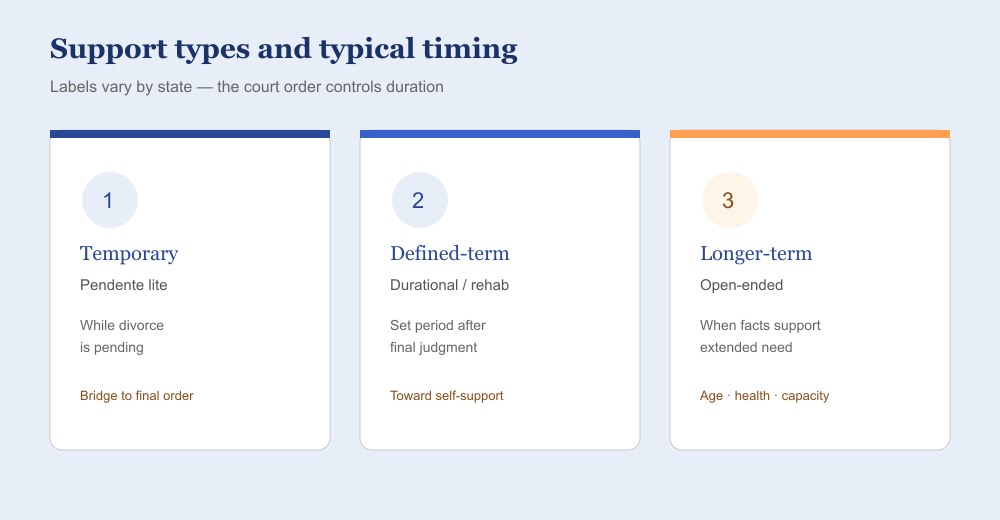
Temporary, defined-term, and longer-term support
Labels vary by state. Florida historically discussed temporary, durational, and permanent alimony; other states use “rehabilitative,” “reimbursement,” or “maintenance.” In Virginia, focus less on the label and more on what the order actually says: when payments start, how long they last, and what ends or changes them.
Temporary / pendente lite
Purpose: May cover immediate financial needs during a pending divorce.
Timing: Often lasts until a final order is entered.
Short-term bridge while the case proceeds.
Defined-term / durational
Purpose: Maintenance while a lower-earning spouse works toward stability.
Timing: Set for a defined period after the divorce.
Support without open-ended maintenance.
Longer-term / open-ended
Purpose: May provide long-term support in compelling circumstances.
Timing: May continue indefinitely when appropriate under state law.
Age, disability, and limited self-support prospects often matter.
| Support type | Typical purpose | Timing | Key considerations |
|---|---|---|---|
| Temporary / pendente lite | May cover immediate financial needs during a pending divorce. | Often lasts until a final order is entered. | Short-term bridge while the case proceeds. |
| Defined-term / durational | Maintenance while a lower-earning spouse works toward stability. | Set for a defined period after the divorce. | Support without open-ended maintenance. |
| Longer-term / open-ended | May provide long-term support in compelling circumstances. | May continue indefinitely when appropriate under state law. | Age, disability, and limited self-support prospects often matter. |
What courts consider
Spousal support is not set by a simple formula. When a court evaluates duration, it looks at the marriage as a whole: its length, the standard of living established during it, each party’s income and earning capacity, age, health, and contributions to the household or career of the other spouse. The paying spouse’s ability to meet an order matters alongside the receiving spouse’s realistic path to financial independence.
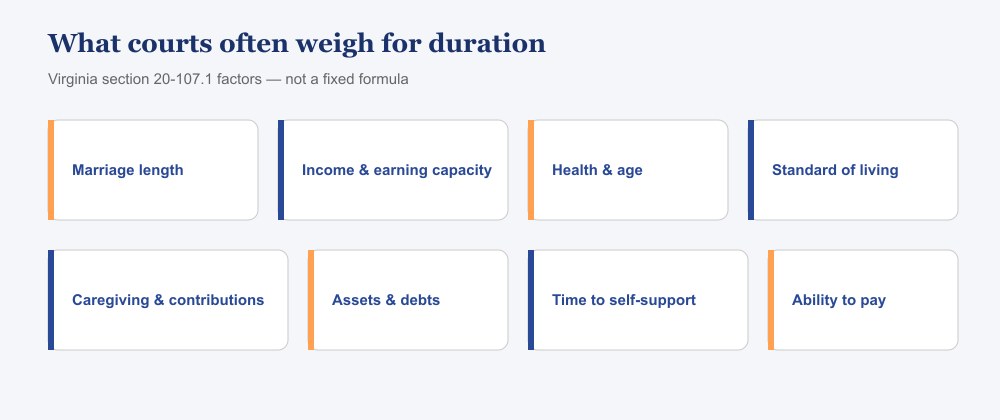
Marriage length: no fixed formula
Marriage duration is often a starting point, but it is not a stopwatch that automatically sets support length. A longer marriage may support a longer award, especially where one spouse stepped back from work or became financially dependent. Yet courts also weigh earning capacity, age, assets, childcare, marital living standards, and time needed for education or workforce re-entry.
In Virginia, people often discuss a “reservation” concept tied to marriage length for preserving the right to seek future support — that is different from how long payments must continue. Details are on the spousal support topic page.
From separation to the final order
Spousal support rarely begins and ends in a single hearing. After separation, one spouse may need immediate help with housing, insurance, and everyday expenses. Temporary support can fill that gap. As the case develops, parties exchange financial information and negotiate where possible. If no agreement is reached, a judge decides and enters a court order.
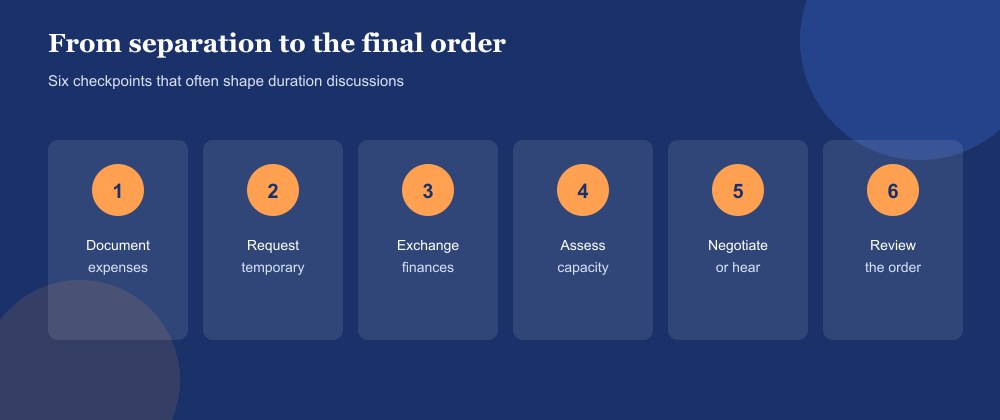
Document expenses. Record housing, insurance, childcare, medical, and everyday costs after separation.
Request temporary support. Ask for short-term help when immediate needs arise while the divorce is pending.
Exchange financial records. Share income, assets, debts, and monthly budgets so both sides have a clear picture.
Assess earning capacity. Consider each spouse’s employment history, health, and realistic ability to earn and pay.
Negotiate or present evidence. Settle terms where possible; otherwise a judge decides after a hearing.
Review the final order. Confirm amount, duration, modification language, and termination conditions in writing.
When support ends or changes
A support award is not always as fixed as its original terms suggest. Spousal support can end earlier when certain life events occur — including when the recipient remarries, a party dies, or another condition in the order is met. A substantial change in income, health, employment, or living arrangements may justify asking the court to change the amount or duration.
Remarriage
Recipient remarriage often ends support unless the order or agreement says otherwise.
Death
Death of either party generally terminates the obligation under Virginia rules.
Material change
Job loss, retirement, illness, or major income shifts may support a modification request.
Order terms
End dates, review dates, and conditions in the court order control what happens next.
Before you stop or reduce payments
- Review the court order for end dates, conditions, and modification language.
- Remarriage, death, or a stated triggering event may end support earlier than expected.
- Document material changes before seeking a formal court modification.
- Do not informally reduce or stop required payments without a new order.
What to gather
A productive conversation about duration starts with a clear record, not estimates. Gather recent pay stubs, tax returns, bank statements, retirement-account information, and a realistic monthly budget. If either spouse experienced illness, a career interruption, or time away from work to care for the family, collect records that explain the effect on earning capacity.
- Pay stubs & tax returns
- Bank & retirement statements
- Monthly budget
- Asset & debt records
- Employment history
- Health / caregiving records
- Prior agreements & orders
- Related correspondence
Frequently asked questions
Answers are general information only — not legal advice for a specific situation.
How long does spousal support usually last?
There is no universal duration. Support may last only during a divorce case, for a defined period while a spouse gains education or employment, or longer where financial dependence, age, disability, or limited earning capacity is shown. In Virginia, the court order under Va. Code § 20-107.1 controls.
Does the length of the marriage determine alimony duration?
Marriage length is important, but it is not the only factor. Courts also consider income, employability, health, age, childcare duties, assets, debts, marital standard of living, and the time needed for a lower-earning spouse to become self-supporting.
What is temporary spousal support?
Temporary spousal support (sometimes called pendente lite support) is paid while the divorce is pending. It can help cover immediate expenses such as housing, insurance, food, and bills until a final settlement or court order is entered.
Can spousal support last indefinitely?
In some cases, longer-term or open-ended support may be ordered—especially after a long marriage or where illness, disability, age, or limited employment prospects make financial independence unlikely. Virginia law and the facts of the case determine what is available.
Does alimony end when the receiving spouse remarries?
In Virginia, unless otherwise provided by stipulation or contract, spousal support generally terminates upon death of either party or remarriage of the spouse receiving support (see Va. Code § 20-109). Always read the order before assuming an obligation has stopped.
Can spousal support be changed after the divorce?
It may be possible to request a modification after a material change in circumstances, such as job loss, retirement, illness, a major income change, or altered living arrangements. A court order generally remains enforceable unless the court formally changes it.
What documents are needed to discuss alimony duration?
Bring pay stubs, tax returns, bank and retirement statements, monthly budgets, debt records, asset information, employment history, and records of health issues or caregiving responsibilities. Existing agreements and temporary support orders are also important.