




Common alimony negotiation mistakes to avoid
General information about negotiating alimony (called spousal support in Virginia). This is not legal advice. See our Virginia spousal support overview and how long support may last for related context.
Negotiating alimony can shape your financial life long after the divorce is final. The most common mistakes often happen early: rushing the process, relying on incomplete financial information, or making moves that appear designed to reduce available income. A clear, well-documented approach helps support a fairer, more durable agreement.
Complete records first
Prepare full financial records before negotiating; salary alone may not reflect true income, assets, debts, or resources.
No hiding money
Never hide, transfer, or overspend to reduce support; unexplained transactions can damage credibility and increase costs.
Facts over feelings
Keep emotions from driving talks; focus on documented needs, earning capacity, caregiving, and sustainable payments.
See the full deal
Evaluate taxes, asset division, duration, modification, and enforcement — not just the monthly amount.
Start with the process
Many common alimony negotiation mistakes begin before anyone discusses a monthly number. In a divorce, support talks work best when both sides understand the financial record, the relevant family-law factors, and the practical timeline of the case. Rushing to a figure based on a friend’s experience, an online calculator, or a sense of what feels fair can obscure the details that matter: income history, future earning capacity, health, parenting arrangements, assets, debt, and the length of the marriage.
Another frequent mistake is treating negotiation as a single conversation rather than a legal and financial process. Gather reliable documents, identify questions that need professional input, and distinguish short-term cash-flow needs from long-term settlement goals. A clear process also helps keep talks from becoming needlessly personal.
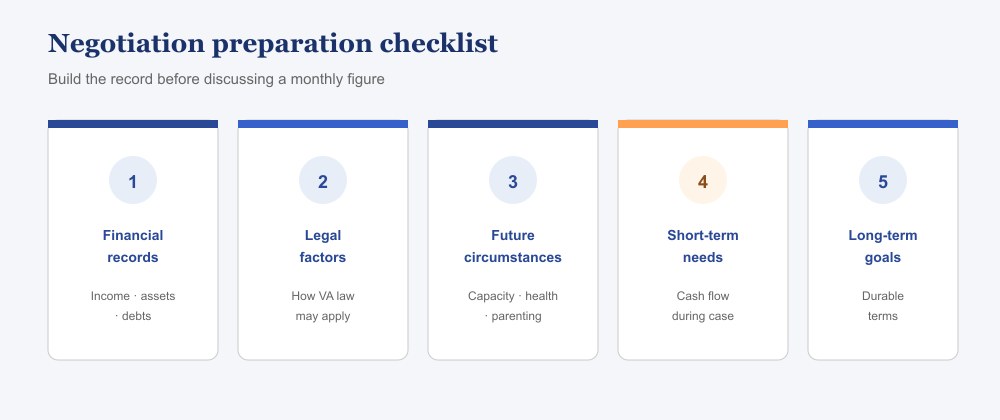
Preparation checklist
| Preparation area | What to gather or clarify | Why it matters |
|---|---|---|
| Financial records | Reliable documents covering income history, assets, and debt | Provides a sound financial basis for discussing support terms. |
| Relevant legal factors | How Virginia family law may apply to the circumstances | Helps both sides understand factors that may affect support negotiations. |
| Future circumstances | Earning capacity, health, parenting arrangements, and marriage length | Ensures discussions consider details beyond a monthly number. |
| Short-term needs | Immediate cash-flow needs | Helps distinguish current financial needs from broader settlement objectives. |
| Long-term settlement goals | Long-term goals and questions needing professional input | Supports terms that are workable, supportable, and less likely to create conflict later. |
Do not overlook full income and assets
When discussing support, do not overlook a spouse’s full income, assets, and current finances. A salary is only one part of the picture. Bonuses, commissions, deferred compensation, business distributions, investment returns, rental income, and valuable benefits may all affect a fair analysis. The same is true of assets: bank accounts, retirement plans, real estate, stock options, and interests in a closely held company can materially change available resources.
Underestimating available income can leave a lower-earning spouse without appropriate assistance. Overestimating it can be equally damaging where income is irregular, a business carries legitimate expenses, or an asset is illiquid. These mistakes can be hard to correct after an agreement or order is entered.
- Collect pay stubs, tax returns, bonuses, commissions, and deferred compensation records.
- Identify investment income, rental proceeds, business distributions, and employment benefits.
- Document bank accounts, retirement plans, real estate, stock options, and business interests.
- Verify debts, legitimate business expenses, irregular income, and illiquid assets.
- Use current disclosures so support is not based on an incomplete snapshot.
Do not spend or hide money to reduce payments
When support is on the table, it can be tempting to move funds or hide money in an effort to reduce payments. Those choices often create larger problems than the payment itself. A court may view sudden transfers, unusual withdrawals, new debt, or undervalued sales of assets as financial misconduct rather than ordinary budgeting. The result can include an adverse finding, added legal fees, and a support calculation based on income or property the court believes is available — even if it has been moved.
People worried about overpaying or avoiding support should focus on defensible facts, not shortcuts. Keep complete records, disclose required accounts and assets, and avoid transactions that cannot be readily explained. Honest disclosure is not merely procedural; it helps prevent costly mistakes that can undermine credibility throughout a case.

No transfers to hide assets
Do not transfer, hide, or undervalue assets to reduce support obligations.
Keep complete records
Document income, expenses, accounts, and major transactions throughout the case.
Disclose promptly
Share required financial information honestly and on time.
Explain big moves
Avoid withdrawals, new debt, or sales you cannot clearly explain.
Protect your financial credibility
- Do not transfer, hide, or undervalue assets to reduce support obligations.
- Keep complete records of income, expenses, accounts, and major transactions.
- Disclose required financial information honestly and promptly.
- Avoid withdrawals, debt, or sales you cannot clearly explain.
Letting emotions dictate decisions
Few parts of a divorce feel as personal as negotiating support. The monthly number can seem to measure sacrifice, betrayal, or future security, which makes it easy for anger, fear, or spite to take over. Letting emotions dictate decisions often turns a practical discussion into a prolonged fight — one that costs more, takes longer, and leaves both parties with less control.
A request for the highest amount possible may feel like a necessary stand; resistance may feel like self-protection. Neither position necessarily reflects the facts that matter most: income, earning capacity, the length of the marriage, caregiving responsibilities, health, and realistic post-divorce budgets. Productive negotiation separates positions from interests — for example, dependable housing while re-entering the workforce versus a payment structure that remains sustainable through variable income.
Look beyond the monthly amount
The monthly figure is important, but it is rarely the whole financial story. An agreement should be assessed against the complete division of assets, each person’s earning capacity, the duration and terms of support, and the tax consequences of every proposed arrangement. Focusing only on what is paid each month can be a costly mistake: a lower payment may be paired with a larger asset concession, while a higher payment may provide flexibility needed during a transition.
The right structure can also reduce payments over time through a planned review, a step-down schedule, or terms linked to retirement or changed income. Conversely, accepting an arrangement without modelling its long-term effect can lead to overpaying or leaving essential protections out of the agreement. Before settling, compare the after-tax value of support and property over several years — not simply the headline monthly number.
Questions before signing
Before signing, pause long enough to test whether the terms will still make sense after the immediate stress of separation has passed. Incomplete financial disclosure is behind many support mistakes. Vague language accepted simply to finish the process is another. Independent legal review is especially important when an agreement waives future rights or limits court review.
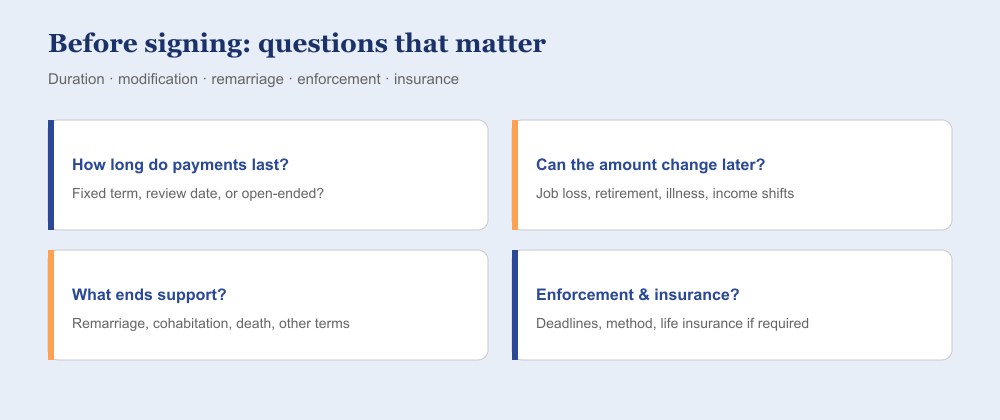
Duration
How long do payments last, and is there a review or end date?
Modification
Can the amount change with job loss, retirement, illness, or a major income shift?
Ending events
What happens if either former spouse remarries or cohabits?
Assumptions
Which income figures, assets, debts, and tax assumptions support the payment?
Child-related costs
How do custody and child expenses interact with spousal support?
Enforcement
Are deadlines, payment method, insurance, and modification procedures clear?
Frequently asked questions
Answers are general information only — not legal advice for a specific situation.
What financial documents should I review before negotiating alimony?
Review tax returns, pay stubs, bank and investment statements, retirement accounts, business records, debt statements, real-estate documents, and records of bonuses or commissions. Complete, current disclosure helps ensure support discussions reflect actual income, assets, expenses, and future financial needs.
Can alimony be changed after a divorce agreement is signed?
It depends on Virginia law and the agreement’s language. A substantial change such as job loss, illness, retirement, or a major income change may permit modification in some cases. Some agreements limit or waive future changes, so review modification terms carefully before signing.
What should an alimony agreement include besides the monthly payment?
It should state the payment amount, duration, due dates, method of payment, tax assumptions, review or modification terms, events that end support, insurance requirements, enforcement procedures, and how changes in income or circumstances will be handled.